
It's late July in Melbourne and that means several things in this city; rain, cold, dismal footy and the latest version of our venerable film festival.
The 64th edition of MIFF has a typically sprawling program, covering all the usual bases, and some that are neither typical nor usual (the awesome oddities of the psychedelic 60's program, as one example).
And, as per usual, I will be taking in as many flicks as I can fit in around my usual schedule of staring into space and walking around in the rain. The next two and a bit weeks I will be spending a lot of time in the dark, eating a lot of Eucalyptus lollies, watching a lot of movies and sharing my hodgepodge film knowledge with anyone who stumbles across this...
MIFF!
CEMETERY OF SPLENDOUR

Rates: * * *
Somewhere in Thailand, Government workers digging up a plot of vacant land are falling ill with a mysterious sleeping sickness. They lapse into a coma and are cared for in a temporary hospital adjacent to the building site. A visiting physic seems to know the score; the site was once a burial ground for kings, and their spirits are forcing the workers to sleep, so they can use their dream energy to battle one another beyond the grave...
Or, quite possibly, something else entirely.
A few years back, I loved Thai director Apichatpong Weerasethakul's hypnotic 'Uncle Boonmee Who Can Recall His Past Lives', a surreal and surprising look at reincarnation and life after death. And this, his follow up, is also brave enough to tackle highbrow concepts. Thematically, this appears to be an examination of the nature of consciousness; how we perceive the world around us, and how we decide what is real and imaginary.
But where 'Boonmee' was absorbing and stimulating, I found this one a bit of a plodder. The film is very slowly paced, and the points the director wants to make are somewhat obscured by long shots of... nothing very much. The sleeping sickness depicted in the film was, sadly, replicated in the audience that I saw this with.
That being said, Weerasethakul knows how to frame a shot, and his graceful camera movements are elegant and stylish. There are also a few laughs along the way, as the characters react straight-faced to some very odd situations. Certainly plenty to think about, if not entirely successful.
SONG OF THE SEA

Rates: * * * * *
In rural Ireland, lighthouse keeper Conor lives on a remote speck with his pregnant wife Bronagh and son Ben. But Bronagh has a secret, one which is revealed the night she gives birth; she is a Selkie, a mythical creature who turns into a seal when she enters the ocean. After Bronagh mysteriously vanishes, Conor is left to raise his children on his own, sinking into melancholic indifference. Meanwhile, his daughter Saoirse begins to show that she has not only inherited her mother's unusual gifts, but also has domain over a magical song, linked to the fate of all fairy tale creatures. When the nefarious Owl Witch gets wind of events, Ben and Saoirse set off an epic adventure, dodging their enemies while they try and save the day.
But words scarcely do justice to this stunning film; it is, simply, flat out incredible.
Director Tomm Moore has opted for a more traditional approach to the animation, and the loving craft behind this is on display in every scene. The visuals are spectacular, and come with lashings of style. This is connected to a moving story that works, as with the greatest of animated films, for both kids and adults; along with the cute creatures and animals and the zippy plot are some statements about loss, and family, and finding your place in the world.
The vocal cast all do a terrific job, and the music score provides just the right level of folky charm. Every aspect, in fact, works quite brilliantly, and the sum of these expert individual parts is a film that is really quite mind blowing. A visceral, emotional experience that is moving and funny and sad. The best time I've had at the cinema in years.
MEDITERRANEA

Rates: * * * *
Ayiva (Koudous Seihon) and Abas (Alassane Sy) are regular guys and lifelong friends, living in impoverished Burkina Faso. At film's start they make the leap that many Africans have before them; paying people smugglers to help them get to Europe. This perilous journey - more expensive and dangerous then they expect - is successful, but once they have landed in Italy, they soon realise that it is not the lavish worker's paradise they had hoped for.
Cold, hungry and homesick, they are abandoned in a makeshift shanty town on the edge of a small city, fending for themselves and hustling up whatever cash-in-hand work they can get. Ayiva, the hardier of the two, starts to make a go of it, but outside of the boy's immediate worries of food and shelter, underlying social unrest serves to trip them up. Tensions with the local population explode into violence, and Ayiva finds himself trapped; reluctant to return home a failure, frightened of his future in the west.
Taken straight from the headlines of the last few years, this beautifully balanced feature examines the allure of modern Europe. With the world's highest standard of living, it naturally sits as a glittering prize across the Mediterranean, attracting countless numbers of poor people hoping for a better life. And while the Governments of European countries struggle to balance the impact of this influx against their (small l) liberal ideals, the immigrants and locals struggle to find a way to accommodate one another, with very mixed results.
This is a movie that highlights problems then, without easy solutions. These are complex issues, and the film shows the human story behind the political ideology and sound bites that shape the debate. Director Jonas Carpignano keeps a sure hand on the material, mixing different themes and emotions (not all of them negative), and the two leads offer remarkable, naturalistic performances. Powerful stuff.
THE END OF THE TOUR

Rates: * * * *
In 1996 David Foster Wallace (Jason Segal) finished his second novel, 'Infinite Jest', and became an overnight literary sensation. Rapturously received by critics, heavily awarded, it's long, complex narrative was a figure of popular fascination. Intrigued, and a little jealous, struggling writer David Lipsky (Jesse Eisenberg) takes an assignment to profile Wallace for 'Rolling Stone' magazine. The two writers spend a weekend together at the end of Wallace's book tour, chatting, joking and verbally sparring as the journalist tries to make sense of his enigmatic subject.
So the themes of this movie seem very familiar - odd couple on the road, learning things from each other - but this fine biopic steps outside of the genre conventions by daring to be cerebral, and by refusing to offer a pat resolution. Wallace and Lipsky live in a world of ideas and abstraction, and their long, meandering conversations cover nearly every topic imaginable; probing, examining, questioning.
It's a structure that would probably sit more naturally with a play, but the acting here serves to bring the material to life. In what is effectively a two hander, both leads bring their A game; Eisenberg a nervy mix of mixed feelings (envy alongside awe), Segel simply superb as the brainy, verbose misfit, uncomfortable with both fame and obscurity. Despite the sophistication of each man's ideas, both are wracked with uncertainty, confirming that even the smartest and most brilliant among us still find life a puzzle.
SHERPA

Rates: * * * 1/2
5 000 metres above sea level, South Base Camp in Nepal is the gateway to Mount Everest. For climbers around the world, an ascent of the world's highest peak represents a lifelong goal, and improved safety and equipment has made it one that is ever more in reach. Key to a successful expedition are the Indigenous Sherpas, an ethnic minority with a genetic disposition for work at high altitude. Every year, teams of Sherpas do the grunt work to help a few hundred Western adventurers trek from Base Camp to Everest's summit, lugging the gear and supplies while the paying guests take photos.
Australian film maker Jennifer Peedom has taken the Everest industry as her subject and, as good and bad fortune would have it, happened to be on the spot last year when an avalanche killed 12 Sherpas. The bulk of the film documents the aftermath of this event, as the surviving Sherpas try and balance the trauma of the disaster against their need to make a living. They face an unenviable choice; weighing the danger they face on the mountain against large piles of hard currency.
Also on show is some simply stunning imagery; the slopes of Everest glisten, and the crevasses and ice fields the Sherpas have to navigate are nerve janglingly beautiful. The Sherpas themselves have an interesting history, but their conflict with their Western employers is not fully developed. We don't actually hear directly from any of the Sherpa's who refuse to climb - none are interviewed - and so they remain rather remote figures, somewhat peripheral and mysterious. This prevents the film from really hitting on an intellectual level, although it certainly works on a visceral one.
CHARLIE'S COUNTRY

Rates: * * * * 1/2
Living a hand to mouth existence in a remote Indigenous community, the aging Charlie (David Gulpilil) finds himself caught between two worlds; the modern world of white Australia, and the more traditional ways of his ancestors. So Charlie has been given a Government built house, but can't live in it as it has been overrun by his family. And he's happy to live in the bush proper as a hunter, only the local police confiscate his spear (claiming it is a 'dangerous weapon').
The examples soon pile up.
Whichever way Charlie turns, whether to the local white authorities or to his broader Indigenous family, he seems to be blocked. No one will let him be, no one wants to help him and, however fiercely he rejects the symbols of white imperialism, he is drawn to them at the same time (neatly symbolised by Charlie's relationship with cigarettes; he repeatedly bums them, only to destroy them in his campfire each night). Charlie is a man who's relationship with his country has become corrupted, and he lives a life of quiet frustration, angry and disillusioned.
When he finally snaps he sets off on an odyssey that takes in an extended stint in the bush, a spell in a Darwin hospital, a period living in a park in a drunken stupour, finally culminating in his arrest and imprisonment. Gulpilil and director Rolf de Heer use this story arc to provide a kind of state of the nation address, deftly weaving in a number of topical elements. They also touch on events from Gulpilil's own life - his recent jail sentence chief among them - and so balance the sociopolitical commentary with a very human story.
It's a virtuoso effort from both men, and their collaboration here has created something truly memorable. A rich, subtle, thoughtful and angry look at race relations in Australia, that also shines a light on the complex idea of identity. What makes us who we are, and how do we define our place in the world? For most people, this is a question they never ask; for the disenfranchised, it is the defining problem of their lives.
And this is a genuinely great Australian film, among the first rank of any we have produced.
TANGERINE

Rates: * * * *
A day in the life on the streets of LA; trans sex worker Sin Dee Rella (Kitana Kiki Rodriguez) hears from her bestie Alexandra (Mya Taylor) that her boyfriend/pimp has been cheating on her, and much worse, cheating on her with an actual girl ('With a vagina and everything!'). She sets out to confront the cheatee - reasonably certain that her name starts with 'D' - while Alexandra tries to keep her friend in check, and also organise her cabaret debut at a local nightclub. Into this volatile mix steps Razmik (Karren Karagulian), a married cabbie with a thing for trans sex ('What the hell is that?!' he asks, aghast, when a girl hooker he picks up by mistake takes her clothes off). These characters, and many more, are all on a day long collision course, culminating in a riotous showdown at the local 'Donut Time.'
From the drop, this dynamic black comedy gallops along at a frenzied pace, driven by the manic energy of the principal character. Once Sin Dee is set in motion she unleashes like a human tornado, sweeping everything along in her melodramatic wake. Rodriguez's performance is phenomenal, but is well matched by the rest of the cast, who find the empathetic elements in some fairly extreme personas.
Indie director Sean S. Baker filmed this on an iPhone in his own neighbourhood, and this innovative approach adds greatly to the films immediacy.We are dropped into the maelstrom, and left to thrash it out alongside Sin Dee and co. By the time there is a reflective pause near the film's end, the laughs have given way to pathos, and we realise the harshness of these lives. There are no simple morals here, more a universal message about humanity; we are all fundamentally the same, and want the same things, regardless of our individual idiosyncrasies. It is hard to imagine a more topical theme, and it is communicated here with skill and style.
A day in the life on the streets of LA; trans sex worker Sin Dee Rella (Kitana Kiki Rodriguez) hears from her bestie Alexandra (Mya Taylor) that her boyfriend/pimp has been cheating on her, and much worse, cheating on her with an actual girl ('With a vagina and everything!'). She sets out to confront the cheatee - reasonably certain that her name starts with 'D' - while Alexandra tries to keep her friend in check, and also organise her cabaret debut at a local nightclub. Into this volatile mix steps Razmik (Karren Karagulian), a married cabbie with a thing for trans sex ('What the hell is that?!' he asks, aghast, when a girl hooker he picks up by mistake takes her clothes off). These characters, and many more, are all on a day long collision course, culminating in a riotous showdown at the local 'Donut Time.'
From the drop, this dynamic black comedy gallops along at a frenzied pace, driven by the manic energy of the principal character. Once Sin Dee is set in motion she unleashes like a human tornado, sweeping everything along in her melodramatic wake. Rodriguez's performance is phenomenal, but is well matched by the rest of the cast, who find the empathetic elements in some fairly extreme personas.
Indie director Sean S. Baker filmed this on an iPhone in his own neighbourhood, and this innovative approach adds greatly to the films immediacy.We are dropped into the maelstrom, and left to thrash it out alongside Sin Dee and co. By the time there is a reflective pause near the film's end, the laughs have given way to pathos, and we realise the harshness of these lives. There are no simple morals here, more a universal message about humanity; we are all fundamentally the same, and want the same things, regardless of our individual idiosyncrasies. It is hard to imagine a more topical theme, and it is communicated here with skill and style.
HILL OF FREEDOM

Rates: * * * * 1/2
Lonely Japanese teacher Mori (Ryo Kase) comes to Seoul looking for love; he badly wants to rekindle the flame of a relationship he started years beforehand with fellow teacher Kwon (Seo-young Hwa). When he discovers she has taken a leave of absence he decides to wait for her, spending his time in a nearby cafe, 'Hill of Freedom', where he writes daily letters that pour out his feelings. But Mori's careful plan hits a detour. He becomes friendly with the cafe manager Young-sun (a radiant Moon So-ri), a woman whose vivacious attitude hides a fragile soul, and the two become lovers. Kwon finally returns to find a stack of unopened mail, and a big life decision to make.
Charm is a rare quality in the movies, but Korean director Hong Sang-soo has created a romantic comedy-drama that displays it on every front. His simple, gentle film is a paean to lonelyhearts and the warm place that people can create between one other. The film is also funny, and draws laughs from the honest observations of it's characters ('You're weird!' 'Well... you're weird too!'), and more familiar fish-out-of-water material around the cultural differences between Japan and Korea.
Kase and So-ri deliver remarkable, seemingly effortless performances, and their shared scenes are perceptive and witty, their delicate connection genuinely moving. And everything from the music, to the structure (Kwon reads Mori's letters and we see events in flashback), to the lively supporting cast adds to the emotional impact of this warm, winning film. At 66 minutes, this packs a lot into a small run time, and is filmed with remarkable economy, devoid of wasted scenes. A wonder.
HEAD

Rates: * * * 1/2
Most everyone knows 'The Monkees'; a comic riff on The Beatles who starred in a popular, goofy TV show that aired between 1965 and 1968. Perhaps less well known is that they were the creations of Burt Schneider and Bob Rafelson, film producers who became industry legends with counter-culture classics like 'Five Easy Pieces' and 'Easy Rider.' But The Monkees was their first successful idea, and provided a mainstream meal ticket that would help fund their more adventurous efforts later on.
After the show was cancelled in 1968, Rafelson conceived of a feature film as a send off. He enlisted his pal, wannabe writer and actor Jack Nicholson, still a year away from stardom in 'Easy Rider', to write the script. What Nicholson came up with was the anti-Monkees; a borderline avant-garde film that had the fake band deconstruct their own myth, and take pot-shots at everything from the Hollywood system, to rampant commercialism, to the war in Vietnam.
This is 'Head'; a sharp, fast paced and very funny satire of 60's culture that contains a number of surprisingly progressive elements. The cynical view the movie takes of fame seems ahead of it's time, and the frenetic, sketch comedy-like structure was a radical innovation, that would be utilised by more prominent films in the following decade. A critical, and commercial, failure when released, this rollicking time capsule has found a new audience among subsequent generations of film buffs. A hoot.
PHOENIX

Rates: * * *
Nelly (Nina Hoss) is a German Jew who goes into hiding during World War II. Near the end of the war she is denounced (by a person unknown), discovered and sent to Auschwitz. Nelly survives the the camp but is horribly disfigured, and requires plastic surgery that subtly alters her appearance. Meanwhile, her husband Johnny (Ronald Zehrfeld), a gentile, has disappeared in the post war chaos of Berlin, amid rumours that it was him who turned his wife over to the Nazis. When Nelly tracks her husband down he fails to recognise her, believing his wife dead, and instead embroils her in a scam to try and claim a family inheritance, by impersonating... herself!
So the plotting of this noir-ish drama is complex and full of twists, and each of the main characters harbours secrets that only but gradually come to light. Both of which are in the plus column. Unfortunately, the film is hampered by a near glacial pace (things evolve slooowly), and a fundamental lack of credibility in the film's principal relationship. Nelly is near obsessed with her husband, and makes continual sacrifices to please him, which is very difficult to accept as the guy is a total, irredeemable, jerk. He treats Nelly like an appalling pile of garbage when he thinks she is another woman, exactly as he treated her while they were married, pre war. To say nothing of the whole send her off to her death, try and steal her inheritance thing.Why she puts up with any of it is a mystery.
That being said, the film is full of fine performances and is nicely shot and assembled. There are some good moments, among the plodding stretches, and the ending seems to suggest that Nelly may be, finally, coming to her senses (just keep going Nelly, don't look back!). A solid movie, that just falls short of something more.
HEAVEN KNOWS WHAT

Rates: * * * * 1/2
Harley is a tough kid living hard in New York. Her life revolves around heroin, alcohol, hustling up dough and hanging around with her her mates, a wide circle that includes a variety of ages and archetypes. Her horizons are limited and she rarely thinks behind the next half day cycle; where she will sleep that night, and where she will get a 'wake up' fix in the morning. More specific conflict arrives in the shape of two young men she attaches herself to; Ilya (Caleb Landry Jones), a volatile hothead with a full range of issues, and manic Mike (Buddy Duress), a messed up raconteur with a surprisingly gentle soul. The boys butt heads over Harley, who walks a circular path between them, her romantic inclinations as uncertain as any other part of her aimless life.
Directing duo Joshua and Ben Safdie's remarkable new film takes us on a tour of the seedy side of modern New York. Behind the glitz of the Big Apple's tourist park facade, things haven't changed much since 'Taxi Driver' and 'Midnight Cowboy', and the directors have assembled a stunning cast of eccentrics that would fit right in to either of those classics.
Newcomer Arielle Holmes provides a believable lead as Harley, and she certainly knows the territory; the film is based on her book 'Mad Love in New York City', a memoir of her years on the streets. But the whole cast is just overflowing with vibrant performances, Jones and Duress chief among them, backed by countless others. The real life locations, and grungy, cluttered production design add to the ring of authenticity this movie carries, which then adds weight to its emotional heft.
You simply feel like you are right on the street alongside these chaotic kids, sharing their mixed up lives for a bit, And the writing/directing group have done all concerned a service by showing them as multi-dimensional; they are funny and smart and thoughful, and also irrational, messed up and difficult. It's a potent combination, and this is a brilliant film.
TWO SHOTS FIRED

Rates: * * * *
Mariano (Rafael Federman) finds a handgun while he is mowing his parents lawn. On a whim, he decides to kill himself with it (he later tells his shrink that the day was just too hot), but miraculously survives unscathed. The bullet that lodges in his chest does have an impact though; it disrupts Mariano's ability to play the medieval flute. Meanwhile, his brother starts dating the taciturn local hottie, who has been breaking up with her real boyfriend for two years, the family dog mysteriously vanishes (or has it been kidnapped?), and the boys mother endures a hellish weekend at the beach, unable to escape from some strangers who invite themselves along.
Ultra dry, darkly comic, and very assured, Argentinian director Martin Rejtman has assembled a consistently surprising look at contemporary existence. Inter-personal relationships are the main game here, specifically how perceived norms of behaviour are being re-written in this uber-connected, ultra public era. The only thing surprising about the increasingly eccentric ways that people behave, is that no one is surprised by anything anymore; truly, anything goes.
A witty and perceptive treat for anyone on this movie's wavelength, probably a bit of a bore for anyone who isn't.
Audience Reaction Note: Two young girls were walking out of the cinema ahead of me. One turned to the other and said (super enthusiastic) 'So what did you think?!' Her mate gave her a sour, miserable look and shook her head vigorously. 'Oh no!' the first one said, 'I'm so sorry!' And she gave her mate a hug.
ARABIAN NIGHTS - VOLUME 1

Rates: * *
We open with an extended montage of a shipyard closing down, while recently sacked workers reminisce about the good old days via voice over. Then the director of the film appears and talks direct to camera before running off, his crew in hot pursuit. Then! We introduce a medieval fairy tale character who explains that she has to tell a tale a day, to keep herself alive. Then!! We lurch awkwardly into one of her stories, back in the present day again, as grotesque financiers with raging hardons destroy the European economy for no reason. Then...
And so on, and on... and on.
So; 'Arabian Nights' is about the debt crisis in Europe, specifically Portugal, and the downside of the economic austerity policies that the Portugese Government adopted. To tackle this hefty topic, director Miguel Gomes has concocted a trilogy of two hour movies, each subdivided into several smaller sections, where fairy tales from '1001 Nights' are converted - for no obvious reason - into metaphors that highlight different aspects of the issue.
Very heavy handed metaphors.
Gomes' film has been rapturously received wherever it has played - it recently won the top prize at the Sydney Film Fest, among many other plaudits - so I was really a bit sombre that it left me so cold. But I found it slow, dull and, worst of all, thoroughly unsubtle. A number of the sequences drag on endlessly, while some are just embarrassingly juvenile; the bit with the randy bankers is like something you would find in a student film, and not a good one.
As the style settles down in the second half there are, at least, a few good moments; the last of the mini stories, focusing on a depressed counselor, is easily the best. But this cumbersome polemic is mostly just a dreary exercise in self indulgence. Complex and convoluted, with a hard left agenda firmly on its sleeve, some people will undoubtedly be thrilled by this... while a few of us, me at least, were just a bit underwhelmed.
99 HOMES
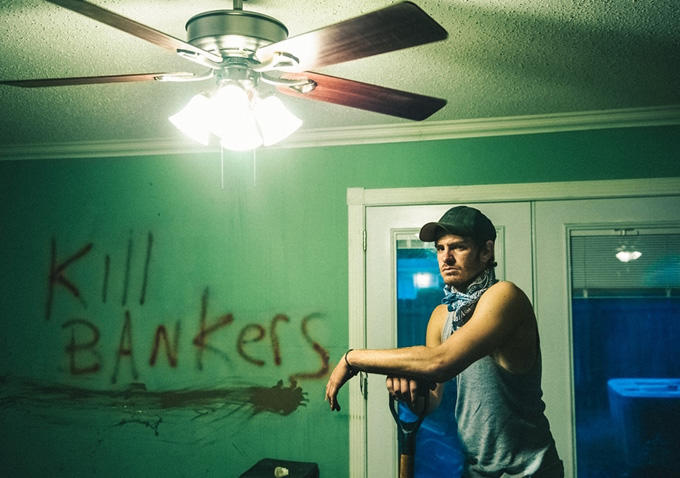
Rates: * * * *
Dennis Nash (Andrew Garfield) is a hard scrabble construction worker with useful skills no one needs; he's a plumber, electrician, labourer, roofer and bricklayer, all in one. But the economic collapse in America has flattened the housing market, and no one wants anything constructed. On the flipside of the same coin, predatory real estate broker Ric Carver (Michael Shannon) has found a way to make cash from chaos, helping banks foreclose on their struggling clients and then snapping up the vacant properties for a song. When Dennis loses his house and can't find work he is drawn into Carver's orbit; reluctantly at first, he is quickly seduced when his assignments, and paychecks, increase.
Serving almost as a companion piece to 'Mississippi Grind' (see below), but with a much tougher message, '99 Homes' focuses on the dark side of modern America. Driving the story, Carver is a boo-hiss villain in classic movie fashion; while doing reprehensible things and corrupting everything he touches, he is also charming and charismatic, with a line of patter that can spin heads (and wouldn't look out of place at a Republican convention). Shannon, one of America's finest character actors, takes to the role with gusto and comes across like a force of nature; never stumped, always hustling, eyes forever on the prize. Garfield's more likable offsider trails in his wake, but how could you not?
Filmed in a straightforward fashion, leaving the events to tell the story, 'Homes' packs a simple punch. The pressure that the characters are under is well conveyed, and bring a layer of tension to even the simplest of actions. Stripped back, Carver's message is one of survival; sink or swim. Why anyone would want to live in a society where that is the principal ethos is never posed: everyone is too busy trying to stay afloat.
MISSISSIPPI GRIND

Rates: * * * *
Gerry (Ben Mendelsohn) is a working class loser with a gambling problem. Curtis (Ryan Reynolds) is a energetic free spirit who seems to attract good fortune. The pair cross paths at a low rent poker game and decide, on a whim, to team up and hit the road, headed down the Mississippi to a high stakes poker game and hustling up some action en route.
Like a time traveler arriving from the 1970's, 'Mississippi Grind' serves as a winning homage to that decades fascination with character over plot. Echoing classic two handers like 'Scarecrow' and 'Midnight Cowboy', 'Grind' pitches two opposites together and puts them in constant, low key peril. Gerry and Curtis are permanently on the lookout for cash, food and shelter, the basic necessities. Nominally, this in the service of their dream of hitting it big, but in reality it is simply the fabric of their restless lives. Despite their differences, neither man is capable of making the choices and compromises that would provide a more stable existence.
Directing team Anna Boden and Ryan Fleck are best known for their 2006 Ryan Gosling vehicle 'Half Nelson,' a film that shares 'Grind's' interest in regular people living at the fringe. Reynolds and (especially) Mendelsohn fully inhabit their roles and show a lot of onscreen chemistry; some of the best scenes in this are when the two unlikely pals are just shooting the shit, talking about nothing but communicating volumes. This gentle, well observed movie is a real actors showcase, that also serves to highlight that the 70's are back in more ways than one; Vietnam and the Oil Shock now replaced by the war on terror and the GFC... Two Woodfords!
Eccentric Audience Note: The old bloke I was sitting next to leaned over, about halfway through the movie, and asked me 'Is that Ben Mendelsohn?' Key question really. Later, he got his paper copy of the MIFF program out and tried to read it by the light of the screen.
THE LOBSTER

Rates: * * * 1/2
Anyone who has ever been single will know the score; you will be set up with people, you will be repeatedly asked 'are you seeing anyone?', and you will be bombarded by ads and movies that try and make you feel like a failure. As a logical extension of all this comes 'The Lobster,' the Jury prize winner from Cannes this year, that imagines a parallel universe where singledom is not just singled out, but criminal.
In this dystopian world everyone who becomes single is sent to The Hotel, where they are given 45 days to find a partner from among the other guests, or else be transformed into an animal. The icily efficient hotel staff try and aid their guests on this task by providing seminars on why singledom is inadequate, and by punishing guests that break the strict rules governing their behaviour (masturbation and smoking are not permitted).
Meanwhile, in the surrounding forest, a ragged band of singles, 'Loners', live by an opposite, but equally arcane, set of rules. They are not allowed to form attachments with anyone else, with even more severe punishments for infractions. On top of this, the hotel guests and the Loners are engaged in a half-hearted kind of civil war, both attempting to disrupt each others systems from time to time.
So what to make of all of this?
In one way, the answer is fairly obvious: Both of these systems are wrong!
Which is to say, some of the metaphors used here are a bit obvious. The director, Yorgos Lanthimos, has a number of points to make; our current obsession with relationships is unhealthy, excessive social restrictions cause problems, and love cannot be manufactured. But he hammers these ideas home so relentlessly, particularity in the film's second half, that what starts out fresh eventually becomes tiresome. The characters wear out their welcome and the sheer artificiality of the film's world wears thin.
That being said, this is still a unique view of relationship dynamics in the modern world, and deserves praise for originality. The movie works best as a black comedy, and there are a number of hilarious, and hilariously awkward, moments as it plays out. As well as one where the whole audience went: 'GASP!'
A mixed bag, that will engender a range of responses.
DAISIES

Rates: * * * 1/2
In the 1960's film, and the arts more generally, were a serious business, at least for anyone on the left. The film medium was not a bit of frivolity to be enjoyed with your mates between dinner and the pub, but a tool to be used to educate the masses and further your agenda. And, while film is still used for these things today, we don't make films like 'Daisies' anymore.
So I kicked off MIFF this year with this surreal Czech film, a fully wigged out 60's trip replete with multicolured filters, nonsense plot, grim stock footage and two young arnarcho-girls, both named Marie. Marie I and II decide early on to be 'bad', and so embark on a series of strange adventures where they effectively prank anyone who crosses their path; mocking the men they date, disrupting a nightclub and a restaurant, and destroying a lavishly laid out banquet before the (unseen) guests arrive.
The idea, I think, is to treat very serious subjects in a silly way; the girls antics highlighting the hypocrisy inherent in the social order of the day, and taking aim at the consumer culture of the west. There's also a strong feminist undercurrent, and director Vera Chytilova was the only female director active in the Czechoslovakian New Wave at the time. Her bold, experimental film is weird, wild, provocative, often thoughtful, and infinitely strange.


